The Study System
Stop re-reading. Start remembering.
Created by a secondary-school teacher with ten years in the classroom.
The Study System is a 66-page interactive PDF that shows you exactly how to study so that what you learn is still there on exam day. It's built on the two techniques research rates highest, active recall and spaced repetition, and turns them into one daily 75-minute block, a two-week plan and eight fillable templates.
29 € Instant download · 14-day money-back guarantee
Get the System →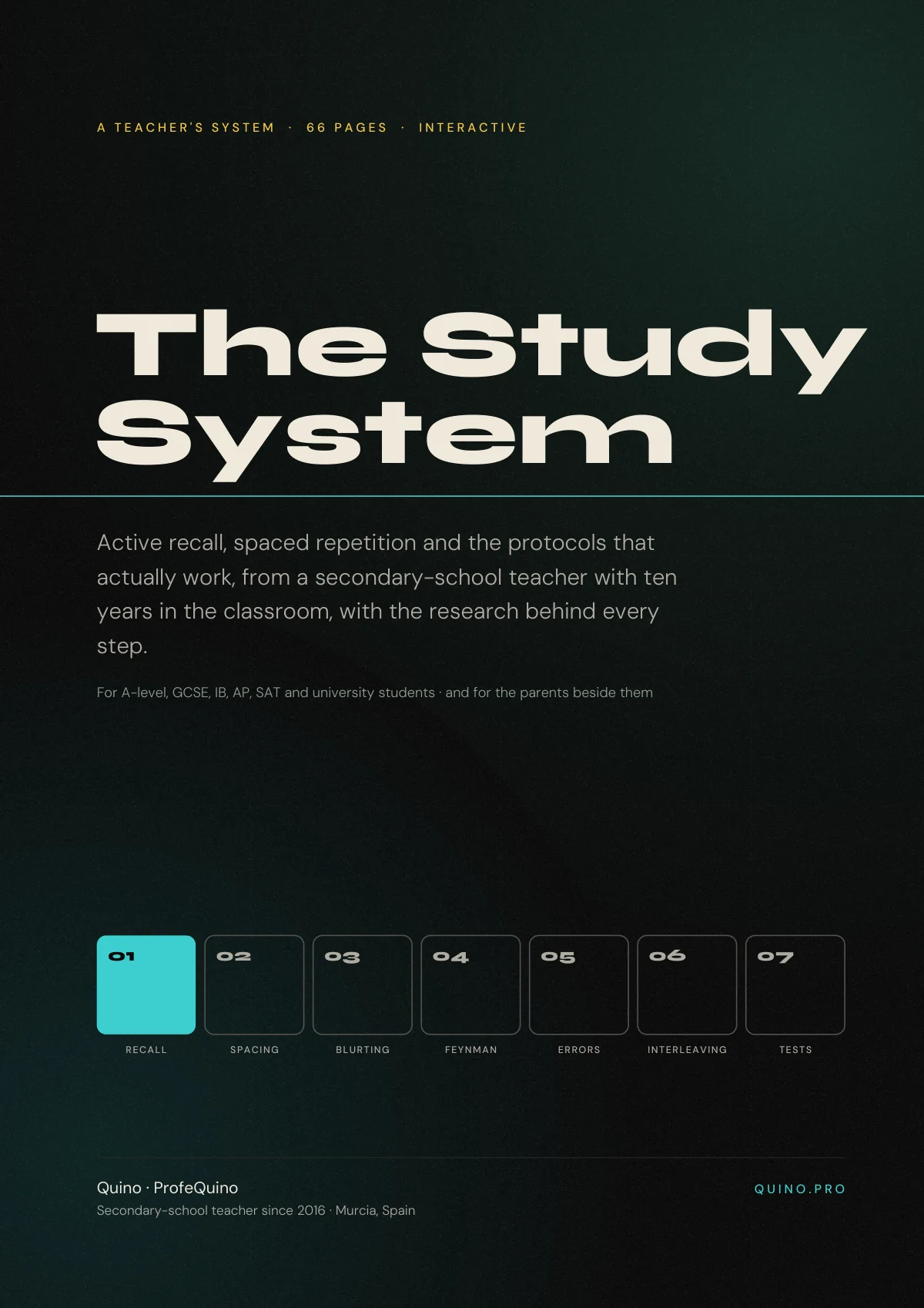
The problem: hours of work, a blank page in the exam
Most students study by re-reading their notes and highlighting. It feels productive. The page looks familiar, the colours look organised, and after the third read-through the chapter feels "done".
Then the exam starts and it's gone.
That isn't laziness, and it isn't a bad memory. It's the wrong tool:
- Re-reading and highlighting train recognition ("I've seen this before").
- Exams test recall ("I can produce this without help").
- The gap between the two is where most lost marks live.
In a well-known experiment, students who re-read a text remembered 40 % of it a week later; students who practised recalling it remembered 61 % (Roediger & Karpicke, 2006). The re-readers had spent more time with the text, and they predicted they'd do better.
If you've ever thought "I worked so hard and still went blank", this is why.
The solution: a system, not a list of tips
The Study System replaces re-reading with methods that make you pull information out of your own head, at the right moments, and use your mistakes as your revision list.
It's based on real research, not study-influencer trends:
- Dunlosky et al. (2013): of ten popular techniques, only two were rated high utility, practice testing and distributed practice. Re-reading, highlighting and summarising were rated low. (See the full ranking of study techniques.)
- Roediger & Karpicke (2006) and Karpicke & Blunt (2011): recall beats re-reading and even concept mapping.
- Cepeda et al. (2006, 2008): spacing beats cramming across hundreds of experiments, with gaps that depend on how far away the exam is.
- Rohrer et al. (2020): mixing problem types raised scores on a delayed test from 38 % to 61 % in real maths classes.
This is the system I give my own students when they ask how to actually remember what they study. The PDF is the full version: every technique, every step, every template.
What's inside
Eight techniques, each with the same five parts
Every technique chapter includes what it is in plain English, the evidence (with the studies named), examples from A-levels, GCSEs, AP, the SAT, IB and university, Quino's Protocol (step by step, with times and an "if you get stuck" line), and common mistakes with fixes.
| Chapter | What you'll be able to do |
|---|---|
| What Actually Works | Understand the research ranking and why the bad techniques feel so good |
| Active Recall | Run the 5-Minute Recall Loop on any topic (preview the method) |
| Spaced Repetition | Know exactly when to review, with or without Anki (preview the method) |
| Blurting | Diagnose a whole topic in ten minutes with the two-pen method |
| The Feynman Technique | Find the gaps in your understanding by explaining it simply |
| The Error Journal | Turn every mistake into targeted revision with five error types |
| Interleaving & Practice Tests | Mix problem types and use past papers properly |
| Your First Two Weeks | Follow a day-by-day plan to make it a habit |
Six "protocol in action" pages
A real, minute-by-minute example for each technique: an A-level Biology recall loop, an AP Chemistry topic followed over five weeks, an IB Biology blurt, a university statistics Feynman, an A-level Maths error journal and an AP Biology past-paper block.
A chapter for parents
What actually helps, what to stop doing, five better questions to ask, "instead of… try…" conversations, and when exam stress needs more than revision tips. (Preview: study tips for parents.)
Eight fillable templates
- T1 Blurting Sheet
- T2 Recall Question Bank
- T3 Spaced Repetition Tracker
- T4 Error Journal
- T5 Feynman Sheet
- T6 Two-Week Planner
- T7 Past Paper Log
- T8 Parent Weekly Check-in
Each one has a pre-filled example row so you can see the level of detail expected. Type into them on screen or print them as many times as you need.
Also inside
- The daily 75-minute block, minute by minute
- Plans for different timelines: 3+ months, 4–12 weeks, under 10 days and 3 days or less
- Exam-week rules and where to find official past papers
- Clickable contents, bookmarks and tick-box self-checks at the end of every chapter
- Full references
Who it's for
- Students preparing for A-levels, GCSEs, IB, AP, the SAT or university exams. The method is the same everywhere; you swap in your own past papers.
- Parents who want to help without becoming the homework police. There's a chapter written for you.
- Anyone tired of re-reading without results, whatever you're studying.
It's probably not for you if you're looking for subject content. It won't teach you photosynthesis, but it will teach you how not to forget it.
How it works
- Download and open it. Instant download after payment. Save a copy, then open it in Adobe Acrobat Reader, Chrome, Edge, macOS Preview or the iOS Files app.
- Read Chapters 1–7 in about two evenings, or take the short route: if your exam is under ten days away, there's a dedicated path straight to what you need.
- Start Day 1 of the two-week plan. One small topic, one 5-Minute Recall Loop, one line in your error journal. Fifteen minutes. Then follow the plan day by day, using the templates.
If you want to see the approach before buying, read how to study for exams. It covers the ranking, the 75-minute block and the outline of the two-week plan.
Who made this

Quino (ProfeQuino) has taught in Spanish secondary schools since 2016, mainly at Colegio Cristo Crucificado in Mula and before that at Colegio Sagrado Corazón in San Javier, with students aged 12 to 18.
"This is the system I give my own students when they ask how to actually remember what they study."
The pattern I kept seeing in class was always the same. The students who spent the most hours with neat, colour-coded notes were often not the ones who remembered the material when it counted. That's what pushed me to collect the methods with the strongest evidence and turn them into something a student can follow on a Tuesday evening, not just read about.
Price and guarantee
| Price | 29 € (VAT included), one-off payment |
|---|---|
| Format | 66-page interactive PDF (A4), fillable templates, bookmarks and clickable contents |
| Delivery | Instant download |
| Guarantee | 14-day money-back guarantee: if the system isn't useful to you, write to hola@quino.pro and I'll refund you in full, no questions |
| Licence | Personal use (you and your own household) |
EU digital content: before paying, you confirm that you want immediate access and that you lose the 14-day right of withdrawal once the download link is sent to you (Art. 103(m) of the Spanish Consumer Act). The money-back guarantee above still applies. See the Terms of Sale and the Privacy Policy.
The Study System · 29 € (VAT included)
66-page interactive PDF · Instant download · 14-day money-back guarantee · Personal use
Secure payment by card or PayPal. You don't need a PayPal account.
Thank you, your copy is ready
Download the PDFStart with Day 1 in Chapter 8: one topic, one 5-Minute Recall Loop, one line in your error journal.
14-day money-back guarantee: if the system isn't useful to you, write to hola@quino.pro and I'll refund you in full, no questions. This guarantee is a voluntary commitment on top of your legal rights.
FAQ
Is this just another study tips PDF?
No. Most study-tips content gives you a list of ideas. This is a system: eight techniques that fit together, a protocol with times for each one, a daily 75-minute block, a two-week plan and eight templates you'll use every week. Every technique is tied to the research behind it, including where that evidence is weaker.
Does it work for A-levels, AP and university?
Yes. The examples come from A-level Biology, Chemistry, Physics and Maths, GCSE History and English, AP Biology, Chemistry, Calculus and US History, the SAT, IB Biology and university Economics, Statistics and Pharmacology. The method works the same way for any exam with content to remember and questions to answer.
Can parents use it?
Yes. There's a full chapter for parents and a fillable Parent Weekly Check-in template. Parents can also read the introduction and the one-page research ranking to understand what their child should be doing, and why.
Is it interactive?
Yes. The contents and cross-references are clickable, there are bookmarks for every chapter, the self-checks are real tick boxes, and all eight templates are fillable on screen. They also print cleanly in black and white.
What if it doesn't help?
Write to hola@quino.pro within 14 days and I'll refund you in full. No questions.
How is this different from free content?
The free pages on this site, like active recall and spaced repetition, explain the main ideas, and you can start using them today. The PDF adds what free content usually leaves out: a protocol for each of eight techniques, the minute-by-minute worked examples, the error-type system, the two-week plan, alternative timelines, the parent chapter and the eight templates, all in one place you can print and fill in.
Will it work if my exam is very soon?
It includes a 10-day route and a 3-day plan. You won't learn everything in that time, but you'll spend your remaining hours on the methods with the best evidence.
Do I need Anki or any app?
No. Anki is explained if you want it, but everything works with paper and the templates.
Ready to stop re-reading?
You don't need more hours. You need the same hours spent on methods that actually work, and a plan you can follow tomorrow.
The Study System · 66-page interactive PDF · 29 € Instant download · 14-day money-back guarantee · Personal use
Use it for two weeks. Then decide if it's worth keeping.